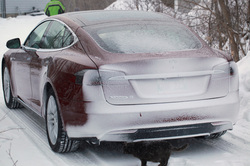
It's about time I mentioned my Tesla Model S. It is a complete game-changer, and is guaranteed to revolutionize the entire auto industry, if lobby groups don't ruin things for us all.
I pre-ordered my Model S on March 27, 2009, within minutes of reservations opening up. I had been following Tesla for many years, before they released the Roadster, which was their proof-of-concept electric vehicle. Tesla Motors is the first successful American car company to start up since the early 1900's - as long as they continue their current trajectory. They are dedicated to 100% electric vehicles, and have engineered the Model S from the ground up to take advantage of the electric powertrain. They also have no dealerships, since in this internet age most of us do our own research online before buying a vehicle, and it eliminates a layer of bureaucracy that merely inflates prices. Consumer Reports recently gave the Model S 99/100, the highest score they've ever given out, and "would have given 110" if there was a 10-minute battery quick-swap option. Tesla recently announced that it indeed will do so over the coming year (it's only useful for long road trips).
I could go into all the reasons why I love the car, and all it's amazing specs, and my minor quibbles (which amount to a bit of a creaky noise that occurred in spring with the changing weather, but is now gone; and the only real negative for me is the distance to the nearest store - Toronto - although they send a service Ranger to my garage at home to do most maintenance and repairs), but you could check out the independent Tesla Motors Club forum for that kind of info. I will say that this is the real deal; this is the most practical, functional car I've ever had. It's the most expensive car by a huge margin, though my providential investment in TSLA stock made that a moot point (bought between $25-35/share, sold between $70/$90, and still have a fair bit invested with the price currently trading at $110). It's time for people to stop wasting time and money on an obsolete, dirty, noisy technology (the internal combustion engine) which burns our non-renewable oil instead of using it for important things like medicine and plastics, and start moving to electric vehicles. The biggest reason is that the electric powertrain is not tied to any specific energy source; I charge on home solar and grid hydro, but even in the most coal-dependent State the electric car will have less emissions than an ICE car, contrary to some FUD faux-articles. Check out the TMC forum for more discussion on that. But it also means in the future, when we discover cold fusion or some magical "unobtainium" fuel from Mars, the electric powertrain will not become obsolete.
It also fits my whole family - 2 kids can sit in the rear jump-seats (and yes, it's actually the safest place to be in the car, and it is the safest car on the road hands-down).
Furthermore, Tesla's 2nd-generation powertrain in the Model S (even their first gen. in the Roadster) is superior to a hundred years of innovation of the ICE powertrain. It is incredibly smooth and responsive, instantly reacting to input, incredibly more efficient, quieter, quicker, and best of all, WAY simpler. This is why hybrids are unfortunately a red herring - carmakers (via pressure by the dealership lobby) want you to believe that hybrids are a necessary bridge, but you end up with an incredibly complex system that means you get the worst of both platforms. Let me tell you, even today, the ICE powertrain is completely unnecessary for 99.9% of your driving needs, unless you are someone who actually drives through the night with minimal stopping more than twice per year on a trip longer than 500 miles. But the dealerships want stuff to break down so they can make a profit. Tesla has a "break-even" service model; their goal is to make money by selling the car, not by maintenance. This is why they make the vast majority of their own parts in-house, and the few troubles they have had with parts come from third-party manufacturers.
I could go on, but instead I'll be driving my car and passing smelly gas stations by (it takes ~10 seconds of my time to refuel: 5s to plug it in, and 5s to unplug it - no wasted time standing doing nothing in between, and it's full every morning). I've had it since January (yes, through the -40 cold snap), and it has performed better than I imagined, and it works fine in winter in Manitoba. I hope other manufacturers follow suit, but they are way behind and lobby groups are doing their best to keep the EV down. I'm doing my part to bring the cost down for the average consumer (Tesla's next goal is to use profits from the S and their upcoming electric crossover, the X to finance their 3rd generation car, a compact 5-seater, which will retail ~$40k Canadian). Tesla's ultimate goal is for every new car on the road to be electric, by setting a standard for all other auto makers to follow. Because once people drive a real electric car (read: Tesla is the only one to currently take advantage of an EV's capabilities), they understand. It's time for those who have money to invest in the future, to invest in things that will bring about change for the better, so that the mass market can become more sustainable by leaving the ICE behind in a museum where it belongs.
PS - I spoke with an avid hot rodder at "Summer in the City" (I brought my car and did some promotion work there). I totally understand that many people have a sentimental attachment to their old cars and have fond memories associated with them. Yes, there will always be a few die-hard gearheads who love the stink and noise and vibration and complexity (ie vulnerability to major breakdowns even with constant maintenance) of the ICE, just as there are some people who still ride horses and carriages and love to shovel horse manure every day. A horse at least has a real personality and can be a friend. To each his own. :)
I pre-ordered my Model S on March 27, 2009, within minutes of reservations opening up. I had been following Tesla for many years, before they released the Roadster, which was their proof-of-concept electric vehicle. Tesla Motors is the first successful American car company to start up since the early 1900's - as long as they continue their current trajectory. They are dedicated to 100% electric vehicles, and have engineered the Model S from the ground up to take advantage of the electric powertrain. They also have no dealerships, since in this internet age most of us do our own research online before buying a vehicle, and it eliminates a layer of bureaucracy that merely inflates prices. Consumer Reports recently gave the Model S 99/100, the highest score they've ever given out, and "would have given 110" if there was a 10-minute battery quick-swap option. Tesla recently announced that it indeed will do so over the coming year (it's only useful for long road trips).
I could go into all the reasons why I love the car, and all it's amazing specs, and my minor quibbles (which amount to a bit of a creaky noise that occurred in spring with the changing weather, but is now gone; and the only real negative for me is the distance to the nearest store - Toronto - although they send a service Ranger to my garage at home to do most maintenance and repairs), but you could check out the independent Tesla Motors Club forum for that kind of info. I will say that this is the real deal; this is the most practical, functional car I've ever had. It's the most expensive car by a huge margin, though my providential investment in TSLA stock made that a moot point (bought between $25-35/share, sold between $70/$90, and still have a fair bit invested with the price currently trading at $110). It's time for people to stop wasting time and money on an obsolete, dirty, noisy technology (the internal combustion engine) which burns our non-renewable oil instead of using it for important things like medicine and plastics, and start moving to electric vehicles. The biggest reason is that the electric powertrain is not tied to any specific energy source; I charge on home solar and grid hydro, but even in the most coal-dependent State the electric car will have less emissions than an ICE car, contrary to some FUD faux-articles. Check out the TMC forum for more discussion on that. But it also means in the future, when we discover cold fusion or some magical "unobtainium" fuel from Mars, the electric powertrain will not become obsolete.
It also fits my whole family - 2 kids can sit in the rear jump-seats (and yes, it's actually the safest place to be in the car, and it is the safest car on the road hands-down).
Furthermore, Tesla's 2nd-generation powertrain in the Model S (even their first gen. in the Roadster) is superior to a hundred years of innovation of the ICE powertrain. It is incredibly smooth and responsive, instantly reacting to input, incredibly more efficient, quieter, quicker, and best of all, WAY simpler. This is why hybrids are unfortunately a red herring - carmakers (via pressure by the dealership lobby) want you to believe that hybrids are a necessary bridge, but you end up with an incredibly complex system that means you get the worst of both platforms. Let me tell you, even today, the ICE powertrain is completely unnecessary for 99.9% of your driving needs, unless you are someone who actually drives through the night with minimal stopping more than twice per year on a trip longer than 500 miles. But the dealerships want stuff to break down so they can make a profit. Tesla has a "break-even" service model; their goal is to make money by selling the car, not by maintenance. This is why they make the vast majority of their own parts in-house, and the few troubles they have had with parts come from third-party manufacturers.
I could go on, but instead I'll be driving my car and passing smelly gas stations by (it takes ~10 seconds of my time to refuel: 5s to plug it in, and 5s to unplug it - no wasted time standing doing nothing in between, and it's full every morning). I've had it since January (yes, through the -40 cold snap), and it has performed better than I imagined, and it works fine in winter in Manitoba. I hope other manufacturers follow suit, but they are way behind and lobby groups are doing their best to keep the EV down. I'm doing my part to bring the cost down for the average consumer (Tesla's next goal is to use profits from the S and their upcoming electric crossover, the X to finance their 3rd generation car, a compact 5-seater, which will retail ~$40k Canadian). Tesla's ultimate goal is for every new car on the road to be electric, by setting a standard for all other auto makers to follow. Because once people drive a real electric car (read: Tesla is the only one to currently take advantage of an EV's capabilities), they understand. It's time for those who have money to invest in the future, to invest in things that will bring about change for the better, so that the mass market can become more sustainable by leaving the ICE behind in a museum where it belongs.
PS - I spoke with an avid hot rodder at "Summer in the City" (I brought my car and did some promotion work there). I totally understand that many people have a sentimental attachment to their old cars and have fond memories associated with them. Yes, there will always be a few die-hard gearheads who love the stink and noise and vibration and complexity (ie vulnerability to major breakdowns even with constant maintenance) of the ICE, just as there are some people who still ride horses and carriages and love to shovel horse manure every day. A horse at least has a real personality and can be a friend. To each his own. :)
 RSS Feed
